“Mini gastric sleeve” is not a standard name for one procedure. People use it for different operations, some of which change the stomach only and some of which also reroute the intestine. This guide explains what each term usually means, so you know which procedure you are comparing.
In short:
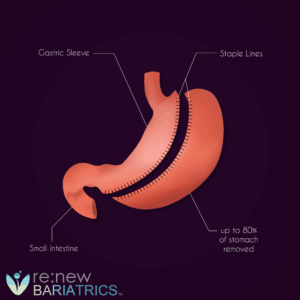
- A gastric sleeve (sleeve gastrectomy) removes about 80% of the stomach. It does not reroute the intestine, and it is permanent.
- A “mini sleeve” usually means a sleeve made a little wider. It is still a sleeve gastrectomy, not a separate operation.
- Endoscopic sleeve gastroplasty (ESG) folds the stomach with stitches through the mouth. Nothing is removed.
- A mini gastric bypass (one-anastomosis gastric bypass, OAGB) is a bypass, not a sleeve. It makes a narrow stomach pouch and connects it to the small intestine.
Why the term is confusing
Clinics and patient forums use “mini sleeve” and “mini gastric” loosely. The earlier version of this article mixed two operations: it described removing part of the stomach, then described a loop of small intestine connected to the stomach. That second step belongs to a mini gastric bypass, not a sleeve. A standard sleeve gastrectomy doesn’t involve surgery on the small intestine (ASMBS).
If someone offers you a “mini” procedure, ask two questions: Is any part of my stomach removed? Is my intestine rerouted? The answers tell you which of the procedures below it is.
Gastric sleeve (sleeve gastrectomy)
The sleeve is laparoscopic surgery done through a few small incisions. The surgeon staples and removes about 80% of the stomach, leaving a narrow, tube-shaped stomach (Mayo Clinic). The intestine isn’t changed. The removed part of the stomach can’t be restored, so the sleeve is permanent (ASMBS).
People can lose about 60% or more of their excess weight within two years (Mayo Clinic). The sleeve can cause new reflux or make existing reflux worse.
A single-incision sleeve (SILS) is the same operation done through one incision at the belly button. A 2023 meta-analysis found similar results to the standard approach, with better cosmetic satisfaction (Ataya et al.). It changes the incisions, not the size of the sleeve.
What a “mini sleeve” usually means
During a sleeve, the surgeon staples along a tube called a bougie, which sets the width of the new stomach. Bougies of 32 to 40 French are typical (StatPearls). A “mini sleeve” usually refers to a sleeve shaped around a wider bougie, which leaves a somewhat larger stomach.
That is a technical choice within the same operation. Part of the stomach is still removed, and the change is still permanent. Studies don’t agree on how much bougie size changes results. A 2013 meta-analysis found fewer leaks with bougies of 40 French or larger and no significant difference in weight loss (StatPearls). A 2025 network meta-analysis found that bougie size affects both weight loss and complications, and said the choice should be individualized (Jumaev et al., 2025). There is no standard definition of a “mini sleeve,” and no reliable weight-loss figure for it as a separate procedure.
Endoscopic sleeve gastroplasty (ESG)
ESG is sometimes called a non-surgical sleeve. A flexible tube with a camera and a suturing device is passed through the mouth, and stitches fold the stomach into a smaller, tube-shaped sleeve. There are no incisions, and nothing is removed (Mayo Clinic).
With lifestyle changes, ESG leads to about 18% to 20% total body weight loss at 12 to 24 months (Mayo Clinic). ESG is not designed to be temporary, and it can be converted to another bariatric surgery later.
Mini gastric bypass (OAGB)
The mini gastric bypass, also called one-anastomosis or single anastomosis gastric bypass, is the procedure the old article was partly describing. The surgeon staples the stomach into a long, narrow pouch and joins a loop of small intestine, usually 150 to 200 cm down, to the pouch with one connection. The rest of the stomach stays in place but is no longer part of the path food takes, and food skips part of the intestine, so you absorb fewer calories (IFSO).
Expected weight loss is 30% to 40% of body weight (IFSO). In the YOMEGA randomized trial, mini bypass was not inferior to Roux-en-Y bypass for weight loss at five years. The authors reported a high rate of reflux after mini bypass, and 8% of mini bypass patients were converted to Roux-en-Y (YOMEGA, 2024). Like other bypasses, it requires vitamins for life, with a higher risk of iron and fat-soluble vitamin deficiency (IFSO).
Side-by-side comparison
| Gastric sleeve | “Mini sleeve” | ESG | Mini gastric bypass | |
|---|---|---|---|---|
| How it’s done | Laparoscopic surgery | Laparoscopic surgery | Through the mouth with an endoscope | Laparoscopic surgery |
| Stomach removed | About 80% | Yes, less than a standard sleeve; no standard amount | None | None; the rest of the stomach stays in place |
| Intestine rerouted | No | No | No | Yes, one connection |
| Permanent? | Yes | Yes | Not designed to be temporary; can be converted later | Can be revised in some cases |
| Reported weight loss | About 60% or more of excess weight within 2 years | No reliable figure | About 18% to 20% of total body weight at 12 to 24 months | 30% to 40% of body weight |
| Price at Renew | $4,899 all-inclusive | Not listed as a separate service | Custom quote, with Dr. Héctor Pérez | $6,299 all-inclusive |
Weight-loss figures come from different sources and are not all measured the same way: excess weight is the weight above a healthy BMI, while total body weight is all of it (Mayo Clinic, sleeve; Mayo Clinic, ESG; IFSO, mini bypass), so compare them with care. Your results depend on your starting weight, diet, activity and follow-up.
Which one fits you?
- You want the most common, well-studied option: the gastric sleeve. It is permanent and can worsen reflux.
- You want no incisions and nothing removed: ESG. At Renew, ESG is for a BMI of 29.5 to 40, and the expected weight loss is lower than with the sleeve.
- You want more weight loss, or have type 2 diabetes: ask about the mini gastric bypass or Roux-en-Y bypass. Tell your surgeon about any heartburn or reflux, because it can affect which bypass is the better choice.
- You were told you need a “mini sleeve”: ask the surgeon how much stomach will be removed, whether the intestine will be rerouted, and what results they expect.
The 2022 ASMBS and IFSO guidelines recommend bariatric surgery for a BMI of 35 or more, and say it should be considered for a BMI of 30 to 34.9 with a metabolic condition such as type 2 diabetes (ASMBS and IFSO, 2022). BMI is only one factor.
Does Renew offer these procedures?
Renew offers the gastric sleeve ($4,899 all-inclusive), the single-incision sleeve (custom quote), ESG (custom quote, with Dr. Héctor Pérez) and the mini gastric bypass ($6,299 all-inclusive, the same as Roux-en-Y). Renew does not list a “mini sleeve” as a separate procedure. The width of your sleeve is part of your surgeon’s plan for your operation.
Frequently asked questions
Is a mini gastric sleeve the same as a mini gastric bypass?
No. A sleeve, of any width, removes part of the stomach and leaves the intestine alone. A mini gastric bypass keeps the stomach in place, makes a narrow pouch and connects it to the small intestine.
Is a mini gastric sleeve reversible?
No. Any sleeve gastrectomy removes part of the stomach, and that can’t be restored. Revision surgery may be possible when it’s medically needed.
Is a mini sleeve safer than a standard sleeve?
There isn’t good evidence that a “mini sleeve” is safer as a separate procedure. Wider bougies have been linked with fewer leaks in some studies, but results vary, and your surgeon chooses the size for your case.
Is ESG a mini sleeve?
ESG is sometimes called that, but it is a different procedure. It uses stitches through the mouth and removes no stomach.
Which procedure leads to the most weight loss?
In studies that compared them directly, the sleeve led to more weight loss than ESG, about 9.6 percentage points more body weight lost across 13 studies (Obesity Surgery, 2026). IFSO reports that weight loss after mini gastric bypass is at least comparable to Roux-en-Y bypass, with a higher risk of some vitamin deficiencies. Your surgeon will recommend an option based on your BMI, health history and goals.
Compare your options with Renew
Send us your health history, and a Renew surgeon will review it and recommend the option that fits your BMI, health and goals. Get your free quote or compare all procedures.
Sources
2022 ASMBS and IFSO Indications for Metabolic and Bariatric Surgery.
American Society for Metabolic and Bariatric Surgery. Bariatric Surgery Procedures.
Mayo Clinic. Sleeve gastrectomy.
Mayo Clinic. Endoscopic sleeve gastroplasty.
International Federation for the Surgery of Obesity and Metabolic Disorders. One Anastomosis Gastric Bypass.
Seeras K, Sankararaman S, Lopez PP. Sleeve Gastrectomy. StatPearls. 2023.
Jumaev N, Teshaev O, Lim I, Kurbanov G. Calibration Bougie Size Selection in Sleeve Gastrectomy. Obes Surg. 2025.
Ataya K, et al. Single-incision vs multiport sleeve gastrectomy meta-analysis. Cureus. 2023.
YOMEGA randomized trial, 5-year results. Lancet Diabetes Endocrinol. 2024.
Sleeve gastrectomy vs endoscopic sleeve gastroplasty: meta-analysis of 13 studies. Obes Surg. 2026.