In recent years, the search for effective weight loss solutions has led many people to consider minimally invasive procedures. These options use small incisions, or none at all, and usually mean less pain and a faster recovery than open surgery. Mexico has become a leading destination for these procedures, with experienced surgeons and much lower prices than in the United States or Canada.
Myths about weight loss procedures persist. Some people believe diet and exercise are always enough, that patients regain all the weight they lose, or that the procedures are too risky. In fact, the risk of death from bariatric surgery in the first year is very low, about the same as gallbladder surgery, according to the American Society for Metabolic and Bariatric Surgery (ASMBS).
Here, we compare four minimally invasive options: the gastric balloon, endoscopic sleeve gastroplasty (ESG), the single-incision gastric sleeve (SILS) and gastric plication. Renew Bariatrics offers the first three in Tijuana and Cancún. We don’t offer gastric plication, and we explain why below.
Minimally invasive options at a glance
| Gastric balloon | ESG | Single-incision sleeve | Gastric plication | |
|---|---|---|---|---|
| How it’s done | Balloon placed through the mouth | Stitches placed through the mouth | Laparoscopic surgery through 1 incision | Laparoscopic surgery through several small incisions |
| Incisions | None | None | 1, at the belly button | Several small incisions |
| Stomach removed | None | None | About 80% | None, the stomach is folded and stitched |
| How long it lasts | Temporary, removed after 6 to 12 months | Not designed to be temporary | Permanent | Weight regain is common in long-term studies |
| Typical weight loss | 10% to 16% of body weight while the balloon is in | About 18% to 21% of body weight at 1 to 2 years, 14% at 6 years | Same as a standard sleeve | Less than a sleeve in comparison studies |
| At Renew | From $3,999, removal $2,599 | Custom quote | Custom quote | Not offered |
Sources for each figure are in the sections below.
Gastric balloon
A gastric balloon is a soft silicone balloon placed in your stomach through the mouth, with no incisions. Once in place, it is filled with saline (salt water). The balloon takes up space in your stomach and slows how fast it empties, so you feel full sooner and eat less (FDA). At Renew, Dr. Héctor Pérez places the Orbera and Spatz balloons in Tijuana and Cancún.
Who it’s for
In the US, Orbera is approved for adults with a BMI of 30 to 40. Spatz3 is approved for a BMI of 35 to 40, or 30 to 34.9 with an obesity-related condition. You may be a good candidate if you:
- Have a BMI of 30 to 40
- Haven’t been able to lose weight, or keep it off, with diet, exercise or medication
- Have not had previous stomach surgery
- Are ready to follow a diet and activity plan, with regular follow-up, while the balloon is in and after it’s removed
Some conditions rule out a balloon, such as active ulcers, inflammatory bowel disease, bleeding disorders, chronic liver disease and pregnancy. If your BMI is over 40, a balloon can sometimes be a first step before surgery.
Results
In the FDA trials, patients lost 10.2% of their body weight with Orbera at 6 months (FDA summary of the Orbera trial) and 15.0% with Spatz3 at 32 weeks (FDA summary of the Spatz3 trial). Patients on diet and lifestyle changes alone lost 3.3%.
Newer reviews support these results. A 2025 meta-analysis of 12 studies and 4,981 patients found an average total weight loss of 16.4% with adjustable balloons such as Spatz, with 5.7% removed early because of intolerance (Xia et al., Obesity Facts, 2025). A 2025 network meta-analysis of randomized trials found that at about 12 months, Spatz3 and ESG led to more weight loss than Orbera (Mrad et al., Gastrointestinal Endoscopy, 2025).
Gastroenterology societies in the US and Europe suggest balloons and endoscopic stomach-reshaping procedures, along with lifestyle changes, for adults with a BMI of 30 or more, or 27 to 29.9 with an obesity-related condition (ASGE and ESGE guideline, 2024).
Pros
- Non-surgical, with no incisions
- Reversible, since the balloon is removed
- Placement usually takes less than 30 minutes, under sedation
Cons
- Temporary. Orbera is removed after about 6 months, and Spatz after up to 12 months. Your habits after removal decide whether the weight stays off.
- Nausea, vomiting and cramping are common in the first days. In the FDA trials, about 17% to 19% of balloons were removed early, most often because of side effects.
- Removal requires a second endoscopy.
Read more about gastric balloon complications.
Cost
Gastric balloon prices in Mexico vary from clinic to clinic, depending on the balloon brand and what’s included. Some advertised prices don’t include removal, a hotel or transportation, so compare what each quote covers.
At Renew Bariatrics, balloon placement starts at $3,999 for Orbera or Spatz, all-inclusive, with sedation, a pre-procedure endoscopy, the balloon, 1 hotel night, transportation, 1 companion and nutritionist aftercare. Removal at Renew is $2,599 and is priced separately, because some patients have their balloon removed by a doctor at home.
Learn more about the gastric balloon in Mexico and gastric balloon cost, or compare the gastric sleeve vs gastric balloon.
Endoscopic sleeve gastroplasty (ESG)
ESG makes your stomach smaller with stitches placed through the mouth, with no incisions and no part of the stomach removed. A flexible tube with a camera and a suturing device (an endoscope) is passed down your throat, and stitches fold the stomach into a smaller, tube-shaped sleeve, so you feel full sooner and eat less (Mayo Clinic). The procedure is done under general anesthesia and takes about 1 to 2.5 hours. At Renew, Dr. Pérez performs ESG in Tijuana and Cancún.
Who it’s for
The FDA authorized the ESG device in 2022 for adults with a BMI of 30 to 50 who haven’t been able to lose weight, or keep it off, through more conservative measures (FDA). It may suit you if you don’t qualify for, or don’t want, traditional bariatric surgery.
Results
- With lifestyle changes, ESG leads to about 18% to 20% total body weight loss at 12 to 24 months (Mayo Clinic).
- In the MERIT randomized trial, patients lost 49.2% of their excess weight at 1 year with ESG, vs 3.2% with lifestyle changes alone, and 80% improved at least one metabolic condition (MERIT trial, Lancet, 2022).
- In a 2026 study of 1,377 patients, ESG led to 21.2% total weight loss at 1 year and 14.4% at 6 years. There were no deaths, and 5.7% of patients had a revision procedure (Galvão Neto et al., Obesity Surgery, 2026).
- In a 2025 network meta-analysis of randomized trials, ESG ranked as the most effective endoscopic weight loss procedure (Mrad et al., Gastrointestinal Endoscopy, 2025).
Pros
- No incisions and no part of the stomach removed
- Most people feel better within a few days
- Can be converted to another bariatric surgery later if needed
Cons
- Less weight loss than a gastric sleeve
- Pain and nausea for several days
- Serious problems are uncommon. In the MERIT trial, 2% of patients had a serious ESG-related adverse event, with no deaths.
Cost
At Renew, ESG is an all-inclusive custom quote, based on your health history and BMI. In the US, ESG costs $11,131 on average, with a range of $7,572 to $19,485 (CareCredit). Learn more about ESG in Mexico.
Single-incision gastric sleeve (SILS)
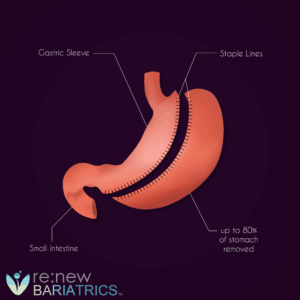
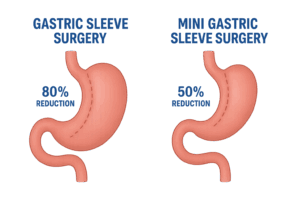
The single-incision sleeve is the same sleeve gastrectomy, done through one small incision at or just above the belly button instead of four to six. The camera and all the instruments pass through that one incision. Inside, the surgery is the same as a standard sleeve: about 80% of the stomach is removed, and the rest is shaped into a narrow tube. The scar is usually hidden in the navel. At Renew, Dr. Pérez performs the single-incision sleeve in Tijuana and Cancún.
Who it’s for
You first need to qualify for a gastric sleeve. Single-incision surgery may suit patients with a lower BMI and few previous abdominal surgeries. It isn’t used for revisions. Dr. Pérez will tell you whether single-incision or a standard sleeve is the better choice for you.
Results
A 2023 meta-analysis of 14 studies and about 3,100 patients found no significant difference between single-incision and standard laparoscopic sleeves in operating time, complications, hospital stay or excess weight loss. Patients rated their cosmetic result better after single-incision surgery (Ataya et al., Cureus).
Pros
- One small scar, usually hidden in the belly button
- The same weight loss as a standard sleeve
- A permanent change to the stomach
Cons
- Irreversible, since part of the stomach is removed
- Not everyone is a candidate
- Lifelong vitamins and diet changes are needed, as with any sleeve
- Longer recovery than a balloon or ESG
Cost
At Renew, the single-incision sleeve is a custom quote after your medical review. The standard laparoscopic sleeve is $4,899 all-inclusive. Learn more about the single-incision gastric sleeve and the gastric sleeve in Mexico.
Gastric plication
Gastric plication is laparoscopic surgery in which the surgeon folds the stomach inward and stitches the folds in place to make it smaller, without removing any stomach tissue. Because nothing is removed, it is sometimes described as reversible.
Renew Bariatrics doesn’t offer gastric plication. Long-term studies have found less weight loss and more repeat surgeries than with the gastric sleeve:
- In a 3-year study of 280 patients, plication patients lost 14.3% of their body weight, vs 23.1% after a sleeve. 14.3% of plication patients needed another operation, vs 1.7% after a sleeve (Tsao et al., Medicina, 2022).
- In a 6-year study, excess weight loss after plication fell from 60.2% at 2 years to 32% at 6 years, 58.3% of patients regained weight and about 21.6% had revision surgery (Abdelgawad et al., Obesity Surgery, 2022).
- A 2022 European guideline, based on a network meta-analysis, recommends the sleeve or gastric bypass over gastric plication (EAES guideline, Surgical Endoscopy, 2022).
- The ASMBS has described gastric plication as investigational, because there isn’t enough data to draw firm conclusions about its safety and effectiveness (as cited in a 2015 review).
If you’re interested in plication because no stomach is removed, ESG uses a similar idea of folding and stitching the stomach, but it is done through the mouth with no incisions. If you want the most durable result from a minimally invasive procedure, ask about the single-incision or standard gastric sleeve.
Which option is right for you?
- Gastric balloon: a BMI of 30 to 40, if you want a temporary, non-surgical option or a first step before surgery.
- ESG: a BMI of 30 to 50, if you want a longer-lasting result without surgery or incisions.
- Single-incision sleeve: if you qualify for a sleeve and want the most weight loss with a single, hidden scar.
BMI alone doesn’t decide. Dr. Pérez reviews your full health history before recommending an option. Calculate your BMI.
Why patients choose Mexico for weight loss procedures
Medical tourism for bariatric procedures has grown quickly in Mexico. Patients from the United States, Canada and other countries choose Mexico for:
- Experienced bariatric surgeons
- Shorter waiting times than in many home countries
- Much lower prices than in the United States or Canada
- All-inclusive packages, with a hospital stay, a hotel and transportation
Cost savings in Mexico
Renew’s all-inclusive packages cover surgeon and anesthesia fees, pre-op testing, the hospital stay, hotel accommodations, private ground transportation and 1 companion. Flights are not included.
| Procedure | Renew Bariatrics, Mexico | United States |
|---|---|---|
| Gastric balloon | From $3,999, removal $2,599 | Varies by provider |
| ESG | Custom quote | $11,131 on average (CareCredit) |
| Single-incision sleeve | Custom quote | Varies by provider |
| Standard gastric sleeve | $4,899 | $17,000 to $26,000 for weight loss surgery, self-pay (ASMBS, via Norton Healthcare) |
HSA and FSA cards are accepted, and financing is available. See our bariatric surgery cost guide and financing options.
Health benefits and safety
Losing weight with one of these options can improve conditions such as high blood pressure, sleep apnea, joint pain, type 2 diabetes and fertility problems. For bariatric surgery overall, the risk of major complications is about 4% and the risk of death is about 0.1%, and both vary by procedure (ASMBS fact sheet, 2025). Your results depend on your diet, activity and follow-up.
Reviews of Dr. Pérez and the Renew team
Dr. Héctor Pérez performs the gastric balloon, ESG and single-incision sleeve at Renew. Here is what a few patients said in 5-star Google reviews:
“This was a great experience! … Staff was very attentive, dr Perez was amazing and comforting. It’s was actually a really easy and smooth procedure as long as you follow all before and after instructions.”
Samantha F., Renew patient
“Best decision I’ve made. Very good communication and coordination. No stress about the trip at all. Everything was taken care of. Dr Perez is the best! The nurses and staff were very friendly and attentive”
Brandi, Renew patient
“Dr. Perez and his staff were amazing! No complains here! Best experience I’ve had. I highly recommend!”
Kim M., Renew patient
Read all patient reviews. Renew is rated 4.9 from 850+ reviews.
Frequently asked questions
What is the least invasive weight loss procedure?
The gastric balloon and ESG are both done through the mouth, with no incisions. The balloon is temporary, and ESG is not designed to be temporary.
Is ESG better than a gastric balloon?
ESG usually leads to more weight loss over a longer time, because the stomach stays smaller after the procedure. A balloon is removed after 6 to 12 months. A 2026 analysis of 6 studies and 5,330 patients found about 2.5 percentage points more total weight loss with ESG, an advantage that grew with longer follow-up, and similar overall adverse event rates (Scientific Reports, 2026). Dr. Pérez will recommend an option based on your BMI, health history and goals.
Is a single-incision sleeve as effective as a standard sleeve?
Yes. In a 2023 meta-analysis, the two had similar weight loss, complications and hospital stays, and patients rated the cosmetic result better after single-incision surgery.
Does Renew offer gastric plication?
No. Long-term studies have found less weight loss and more repeat surgeries after plication than after a gastric sleeve. Renew offers ESG and the single-incision sleeve instead.
How much does a gastric balloon cost in Mexico?
At Renew, placement starts at $3,999 for Orbera or Spatz, all-inclusive, and removal is $2,599. Prices at other clinics vary, so compare what each quote includes.
How much do ESG and the single-incision sleeve cost at Renew?
Both are all-inclusive custom quotes after your medical review. The standard gastric sleeve is $4,899 all-inclusive.
Find your option with Renew Bariatrics
Send us your health history, and Dr. Pérez’s team will review it and recommend the option that fits your BMI, health and goals. Virtual consultations are available. Get your free quote or call (844) 736-3963.